Reflected Light in Shadow: The Rule That Keeps Form Solid
How to paint reflected light in shadow without breaking the form: what bounce light is, why beginners overstate it, and the shadow family rule.
Almost every beginner paints reflected light too bright. It is the single most common way a drawing that was going well suddenly stops looking solid. The shadow side of a head fills with a pale glow, the form flattens out, and nothing you do to the light side fixes it.
The cause is not carelessness. Reflected light genuinely looks brighter than it is, for a reason we can name, and there is one rule that protects you from it.
What reflected light is
Light that misses your subject hits something else and bounces. A table top, a wall, the floor, the sky, a white cloth, your own shirt. Some of that bounced light finds its way onto the parts of your subject that the main light cannot reach, and gently lifts the shadow.
That is reflected light, also called bounce light. Two things about it matter.
It takes the colour of whatever it bounced off. Light bouncing off a red tablecloth carries red into the shadow. Off grass, green. Off a white wall on a grey day, cool grey. This is why shadows are almost never neutral, and why the shadow side of a head lit from a window often turns warm from the floor and cool from the sky at the same time.
It is much weaker than you think. A surface only bounces a fraction of what lands on it, and that fraction has to travel to your subject and hit it at a glancing angle. What arrives is a whisper.
The anatomy of a shadow: where reflected light sits
Reflected light is one zone among several, and mixing up the names is part of why people paint it wrong.
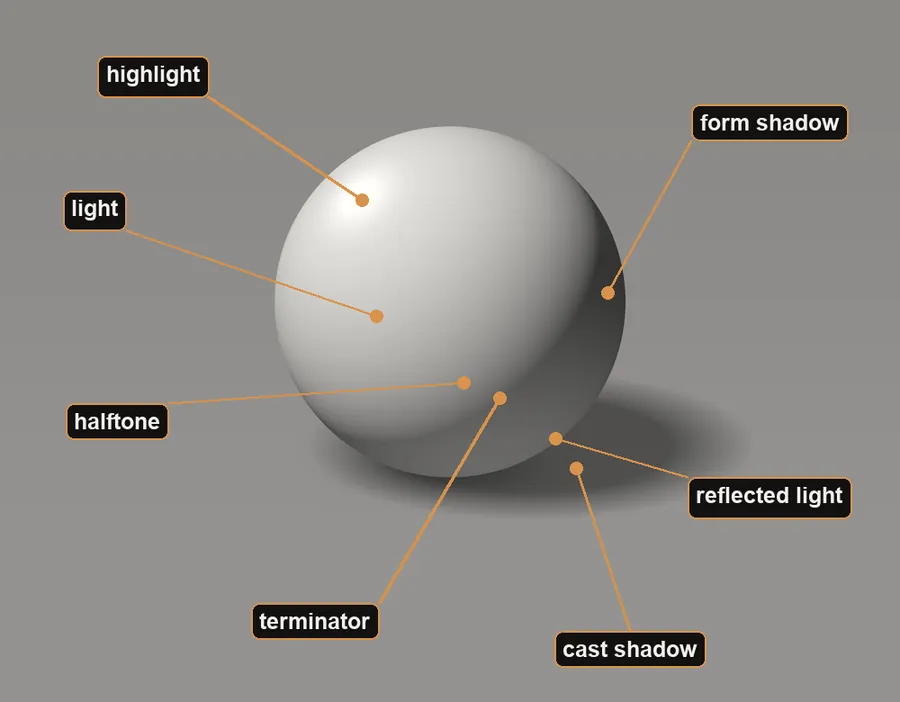
- Light. The planes facing the light source.
- Halftone. Planes turning away from the light. Still lit, just at a slant.
- Terminator. The boundary where the surface turns far enough that direct light stops reaching it. Everything past it is shadow.
- Form shadow. The part of the object turned away from the light. This is where the darkest note on the object lives.
- Reflected light. A faint lift inside the form shadow, on surfaces angled toward whatever is bouncing light back.
- Cast shadow. Not on the object at all. This is the shadow the object throws onto something else.
Two useful observations from that diagram. The darkest part of the object is not the edge, it is the band of form shadow just past the terminator, before any bounce reaches it. And the reflected light sits along the outer edge, which is exactly where a beginner is tempted to run a bright rim.
Why reflected light always looks too bright
Here is the mechanism. Reflected light is surrounded on all sides by the darkest values in your picture. Anything surrounded by dark looks lighter than it measures. That is simultaneous contrast, and it means the faint lift in your shadow presents itself to your eye as a distinctly bright passage.
So you match what you think you see. You mix something noticeably lighter, put it in the shadow, and step back to find the shadow side of the form now competing with the lit side.
The trap is that you were being accurate about your perception. You were just not being accurate about the value.
The shadow family rule
Ateliers put it as a single sentence, and it is worth memorising in this form:
Every value in the shadow family stays darker than every value in the light family.
Or more bluntly: your lightest dark must be darker than your darkest light. Reflected light belongs to the shadow family. It is allowed to be the lightest note in that family. It is not allowed to cross over.
Here is the same sphere twice. The light side is pixel for pixel identical in both. The only thing that changes is the strength of the reflected light.
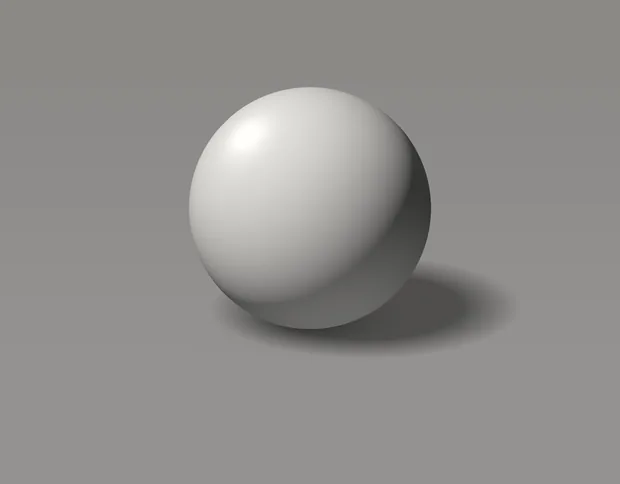
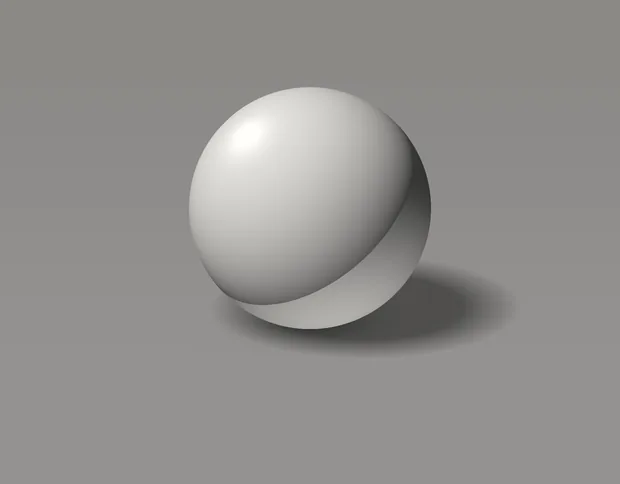
Look at the right-hand ball. The terminator has turned into a hard dark line with light on both sides of it, so instead of one form turning away from you, you see two pale shapes separated by a stripe. That is what “the form falls apart” actually looks like, and it happens the moment reflected light crosses into the light family.
One honest caveat. This is a pictorial rule, not a law of optics. In a room with a white tablecloth and a dark subject, the bounce really can measure brighter than your darkest halftone. The rule survives anyway, because your job is not to transcribe the room. It is to make a form read as solid on a flat surface, and subordinating the shadow family is what does that.
How to paint reflected light
Block the shadow in flat first. Put the whole shadow family down as one unbroken mass at one value, with no reflected light in it at all. Judge that mass against the light side. Only once it reads as a single shape do you go looking for the lift inside it.
Then squint. This is the test that settles every argument. Narrow your eyes until detail drops away. If the reflected light survives squinting as a separate bright note, it is too light. It should melt into the shadow mass and disappear.
Give it one step, not three. In practice, reflected light usually sits about one value step above the form shadow next to it. If you find yourself two or three steps up, you have gone too far.
Do not put it everywhere. Reflected light needs a source and an angle. Work out what is actually bouncing light back, and where it could physically reach. A rim of light run around every shadow edge is a habit, not an observation, and it makes objects look like they have been cut out and lit from behind.
Keep the darkest note near the terminator. Beginners often make the terminator softer and lighter than the shadow behind it. It should be the other way round: darkest just past the terminator, then a gentle lift toward the reflected light.
Common reflected light mistakes
- Reflected light lighter than the halftone. The headline error. Squint and it should vanish.
- A bright rim around every shadow. Applied as a formula rather than observed. Ask what is bouncing.
- Lifting a cast shadow the way you lift a form shadow. Cast shadows do catch bounce toward their outer edges, but the darkest note in the whole picture is usually the contact point where the object physically meets the surface. Keep that black, and let the shadow open up as it travels away.
- Too colourful, not just too light. Bounce carries colour, but a shadow full of saturated reflected colour reads as decoration. Keep the chroma restrained unless the source really is a red cloth six inches away.
- Losing the darkest dark. If every shadow has been lifted by bounce, nothing in the picture is properly dark and the whole thing goes grey.
The fastest way to train this is to change the light and watch the shadow family move. In Art Atelier you can orbit a studio light around a 3D planar head and posterize the shading into flat value steps, which shows you where the shadow family ends and how much room the reflected light really has inside it.
Related: Simultaneous contrast for why the shadow lies to you in the first place, the planar head explained for how the planes decide where the terminator falls, and how to see values like an atelier student for the squinting and notan habits behind all of this.
Practise this in Art Atelier
Orbit a studio light around a 3D planar head, snap to classic presets, and posterize the values into a notan. Free on iOS & Android.
Download the app