The Structure of a Classical Drawing: Learning to See
How a classical drawing is organised: find the terminator, set your darkest dark as a master value, judge every value by comparison, and control your edges.
One of the first things you learn in a classical atelier is that drawing is not primarily about copying what you see. It is about organising what you see.
The structure of a classical drawing rests on a few major relationships, settled before details, anatomy, or beautiful rendering: proportion, rhythm, light and shadow, value, and edges. If these are right, the drawing can remain simple and still feel convincing. If they are wrong, no amount of detail will save it.
A Classical Drawing Begins with Structure
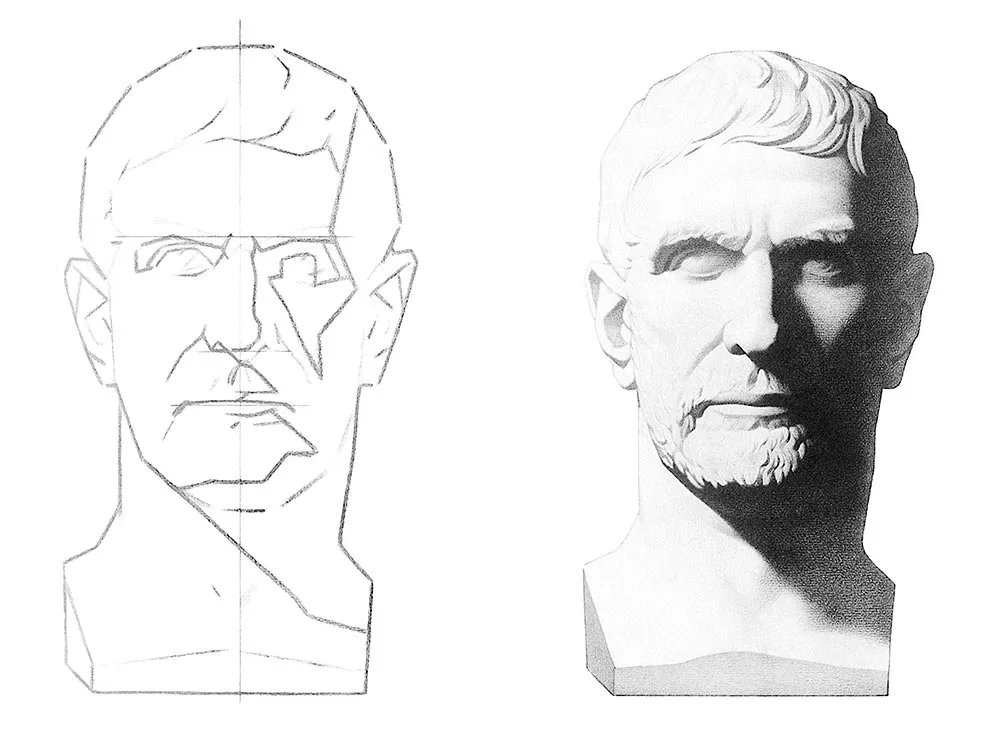
In a Bargue drawing, begin with the outline and the shadow line. But don’t think of the shadow line simply as a dark contour. You are looking for the terminator: the point where the form turns far enough away from the light that direct light no longer reaches it.
Ask yourself:
Where does the light end?
This gives you the fundamental division between the light family and the shadow family.
Once you have found this division, keep the shadow organised. Do not immediately put every dark variation you see into it. A darker midtone on the light side is still part of the light family. Likewise, subtle variations inside the shadow should not destroy the larger shadow mass.
Establish the big relationship first:
Light. Dark.
Then refine.
The Darkest Dark Is Your Master
When beginning a value study, find the darkest dark first. Ideally, locate it around the focal point of the subject and establish it deliberately.
This darkest dark becomes your master value: the one source of truth for the entire drawing.
From there, work through the drawing by comparison. Take each new area and ask:
- Is it darker or lighter than my darkest dark?
- How much lighter?
- Is it darker or lighter than the background?
Never judge a value completely in isolation. Values exist through relationships.
As you continue, you may realise that your darkest dark wasn’t dark enough. Deepen it and reassess the rest. The entire hierarchy should be adjusted in relation to this anchor.
The same principle applies to the background. A contour that appears very dark against a light background may almost disappear against a dark background. The value of the edge is determined not only by the object, but by what surrounds it.
Learn to See the Shadow Line
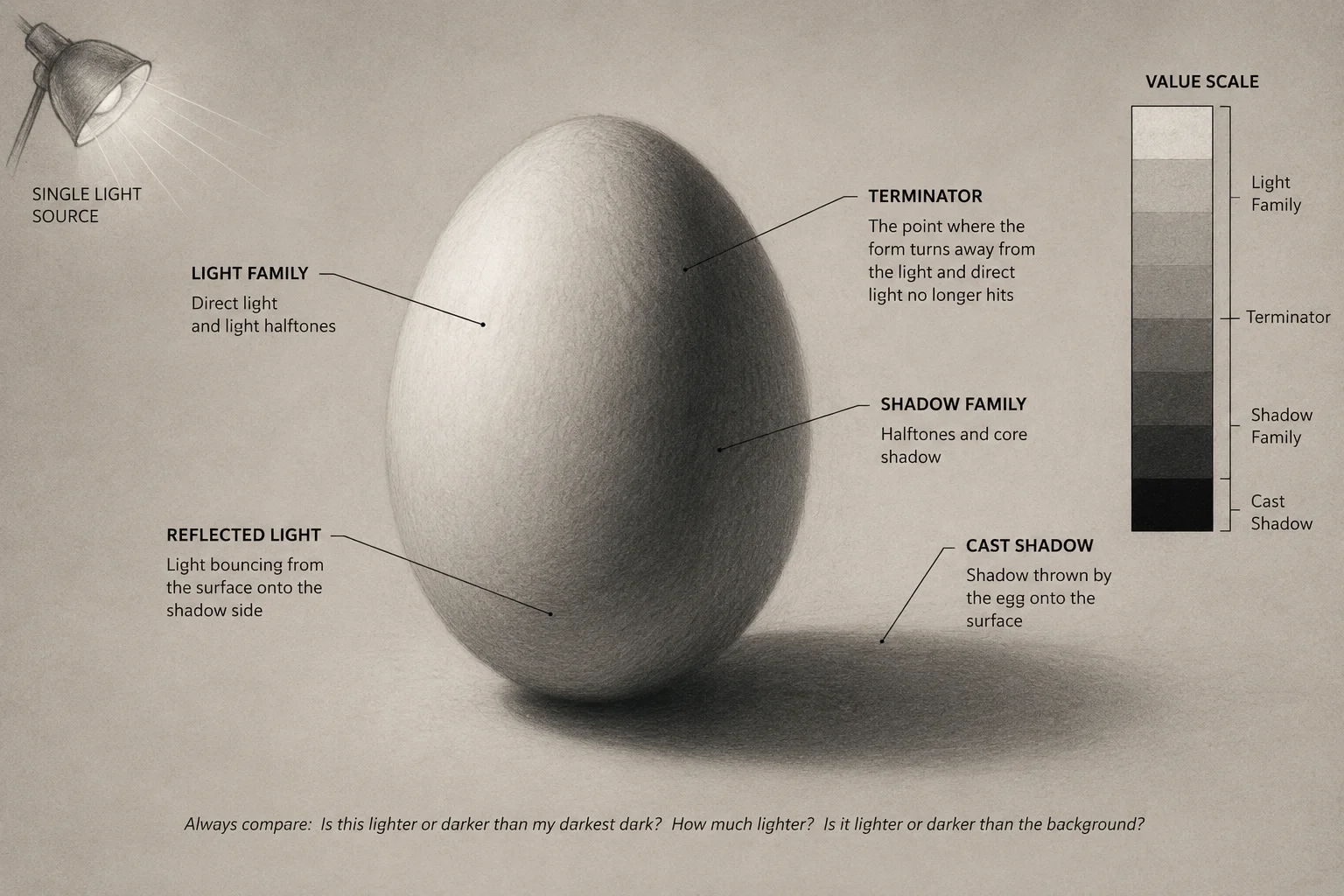
The terminator is not necessarily a hard black line. Think of an egg under a light. Near the shadow line, on the light side, there may be a relatively light value that sits surprisingly close to the shadow value.
This is important: the shadow line is a boundary between value families, not an arbitrary dark stripe.
The transition may be soft as the rounded form turns away from the light. Establish the shadow value clearly, but don’t contaminate it with every darker midtone you see. Keep the major shadow mass coherent before introducing subtle variations.
Within the shadow, you may find a soft line or a lighter passage that describes the turning of the form. These variations are useful, but they remain subordinate to the primary light-and-shadow structure.
Control Your Edges
Once the values are established, begin controlling the edges.
Some edges should be sharp. Others should be soft. Others should disappear completely.
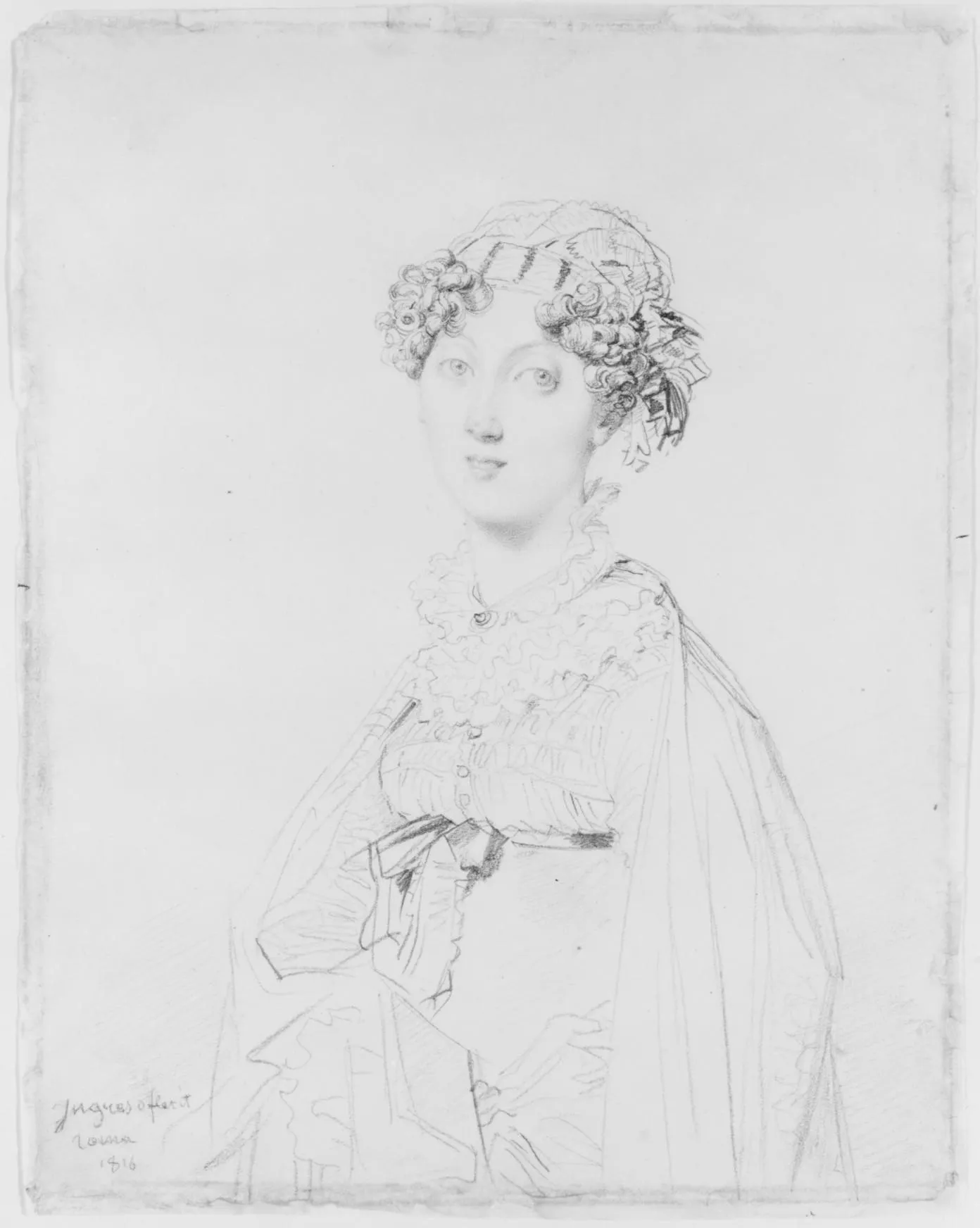
This is one of the great differences between a beginner’s drawing and a mature drawing. A beginner tends to describe every form with an equally strong outline. An experienced draughtsman understands that an edge has a value and a degree of clarity.
When the contour approaches the value of the background, allow it to disappear. If you need to maintain it, keep the contour only slightly darker than the surrounding value rather than forcing a hard black line.
When a contour disappears, that is not a mistake. It tells you something: the values on either side of the edge are close.
Likewise, edges within the shadow can often be softened or lost because the form is no longer receiving enough direct light to reveal a clear separation.
Think of edges as part of the value structure, not decoration added afterwards.
In Figure Drawing, Find the Rhythm
The same principles apply when drawing the figure.
Don’t begin by giving equal attention to every limb. First look for the rhythm of the figure: the movement that connects the major forms.
Find the ribcage. Find the leg that carries the weight. These are major structural anchors. They tell you how the figure is standing and where the weight is organised.
Then look for similar angles between shapes. An angle in the ribcage may echo an angle in the pelvis or leg. These relationships help you construct the figure rather than simply trace its perimeter.
As you find the rhythm line, don’t make every part equally dark. Strengthen certain sections of the rhythm and allow others to remain light or disappear. This creates hierarchy and directs the eye toward what matters.
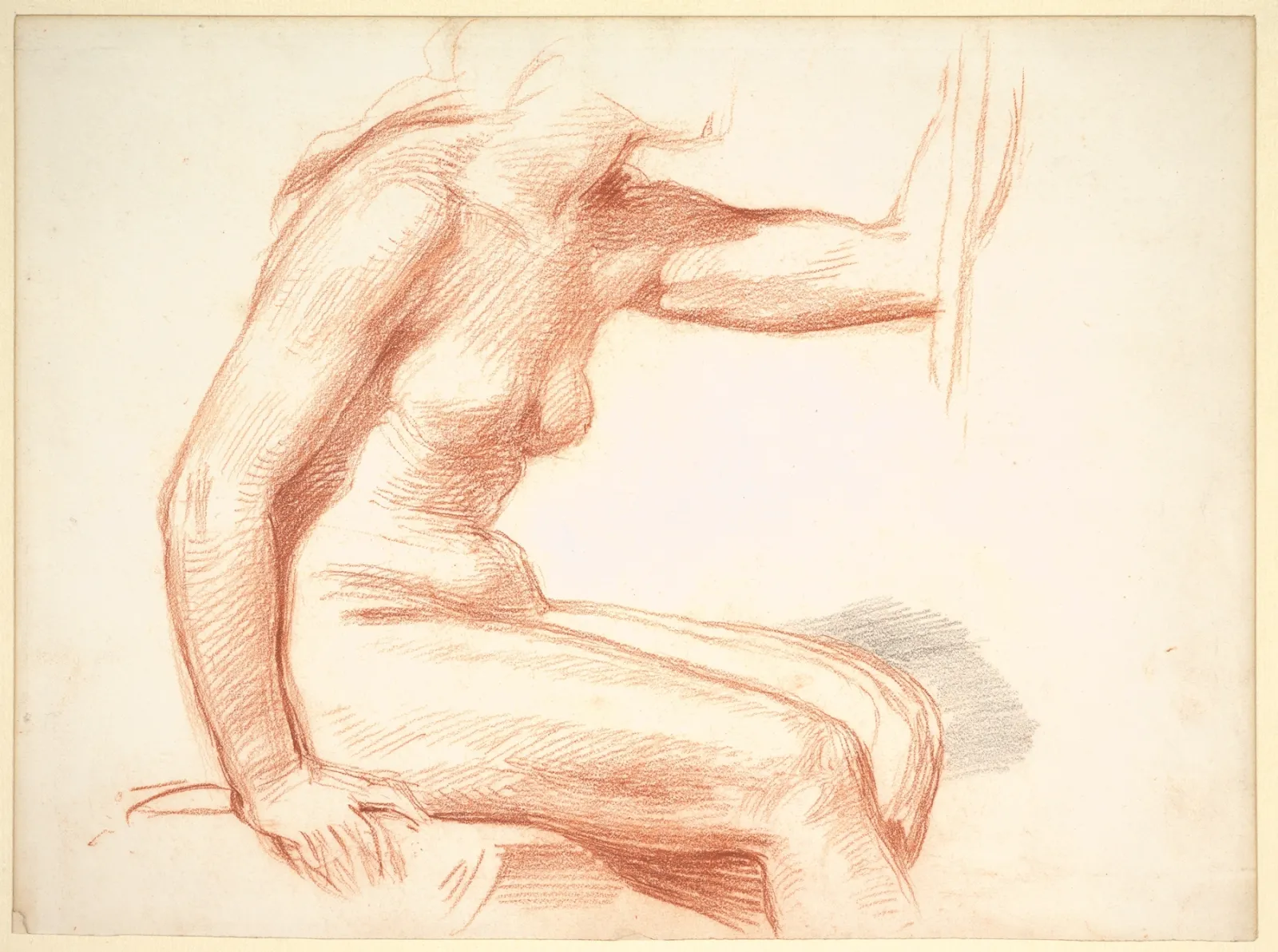
The other limbs can be developed later. If the ribcage and weight-bearing leg are wrong, beautifully rendered hands and feet will not rescue the figure.
Draw Relationships, Not Objects
Ultimately, good drawing comes down to comparison.
- Is this angle similar to another angle?
- Is this value darker or lighter than my master value?
- Where does the light stop?
- Is this edge sharp, soft, or lost?
- Is this contour actually visible, or am I drawing it because I assume an object must have an outline?
These questions move you away from drawing symbols and toward seeing.
A classical drawing is not a collection of accurately copied details. It is an organised hierarchy of structure, rhythm, light, shadow, value, and edges.
Establish the big relationships first. Find the terminator. Set your darkest dark. Compare everything against it and against the background. Then sharpen, soften, or lose your edges according to what the form and light are actually telling you.
These comparisons are easier to practise when you control the light. In Art Atelier you can set a single lamp on a 3D head, rotate it slowly, and watch where the terminator falls; switch on value steps and you can check whether your shadow family really holds together as one mass.
The goal is not to draw everything you see. The goal is to understand what you see well enough to know what needs to be drawn.
Related: How to see values like an atelier student goes deeper on the value families and the value scale this method depends on. Then Loomis vs Reilly vs Asaro for choosing a construction method for the head, and reflected light in shadow for the rule that keeps the shadow mass coherent.
Practise this in Art Atelier
Orbit a studio light around a 3D planar head, snap to classic presets, and posterize the values into a notan. Free on iOS & Android.
Download the app